HYMNES
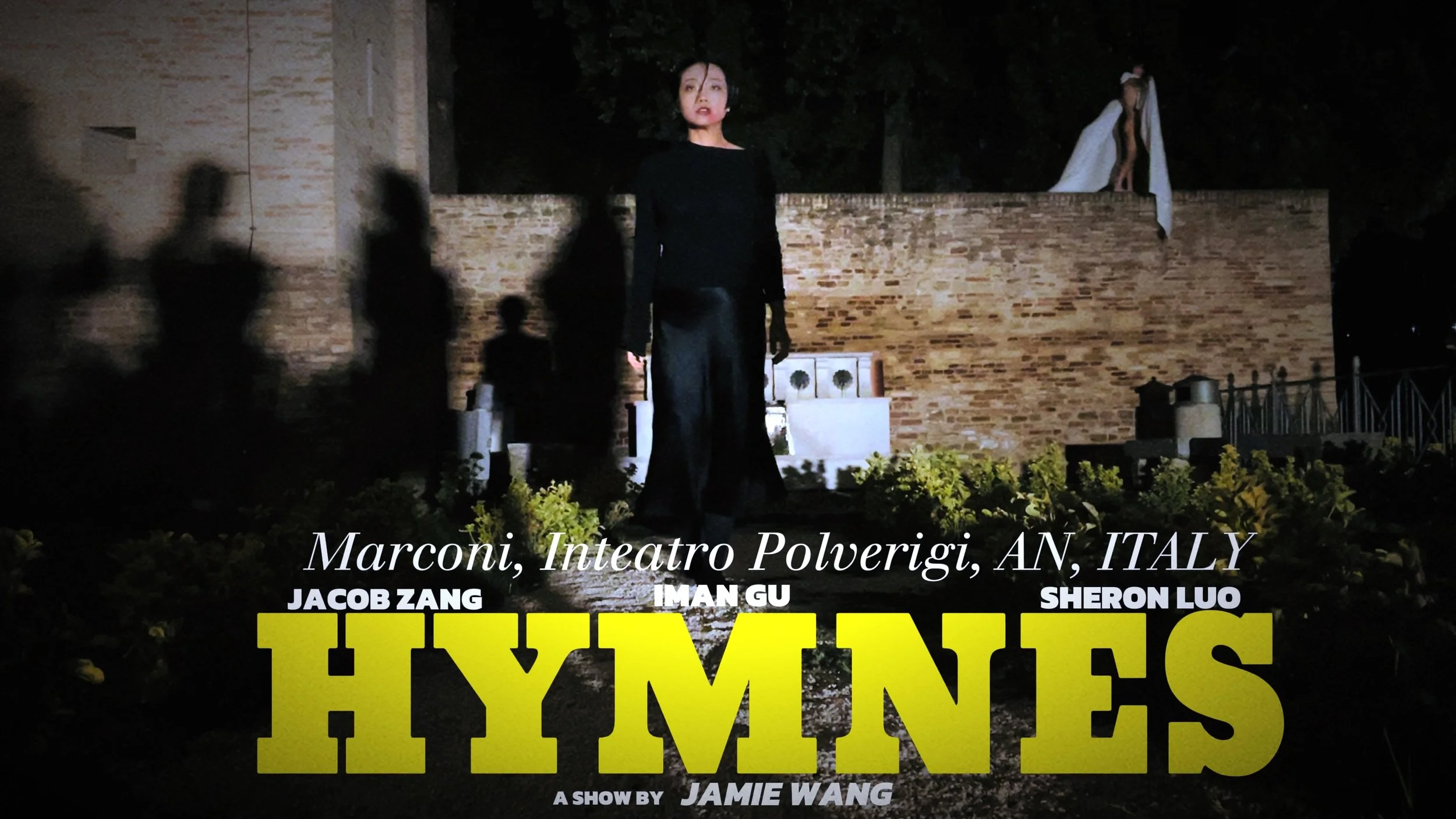



Dusk gathers in a half-ruined monastery and the site sets the tempo. Along the walls the wind creeps and turns. Light fades into night; the fountain keeps a slow, regular count. Pigeons stitch and re-stitch the air. Hymns treats the place as an instrument rather than décor. What is present—wind, light, water, stone—meets what arrives when people assemble: memory, attention, the sensation of being looked at or left out. The monastery becomes a civic room where bodies register what the town has carried forward and what it has let slip.
At the centre sits an echo-soma loop: action produces a trace; the trace returns to shape the next action. A body moves and the environment answers with shadow, sound and drift. In that feedback, private memory and feeling become shareable without explanation, appearing as a surface on a wall, a pressure in the air, a held breath.
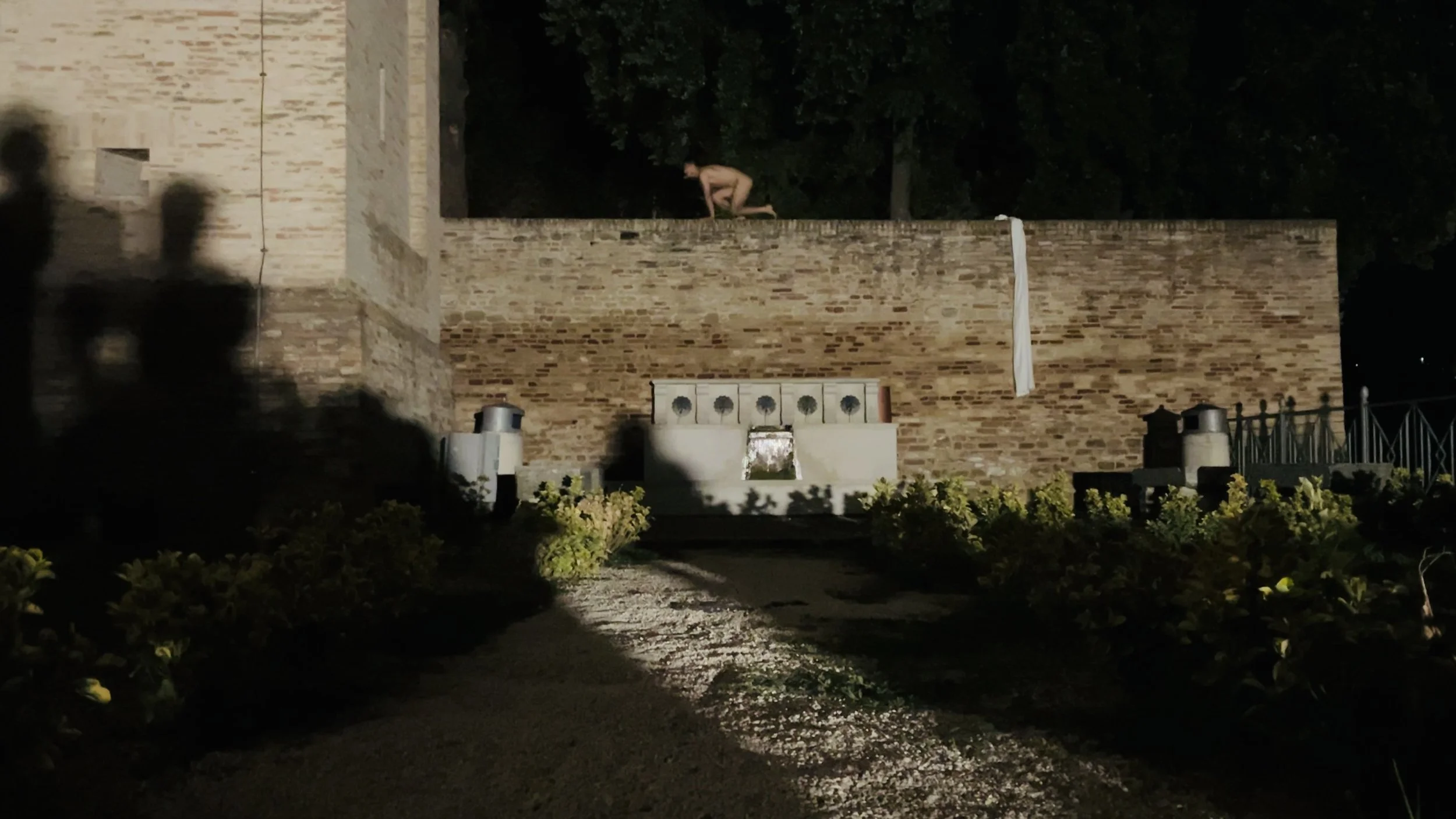
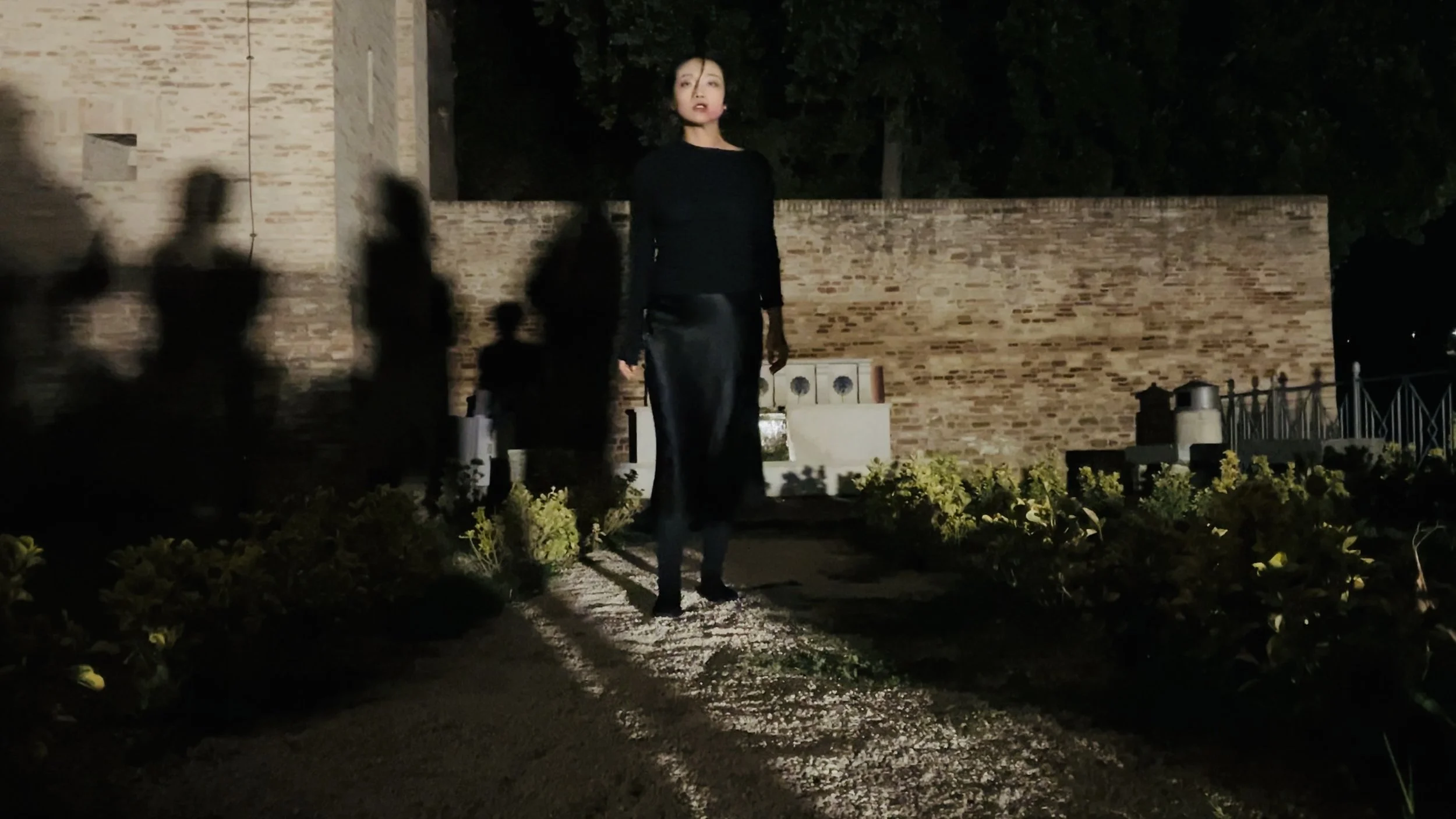
The score remains spare. A man climbs a four-metre wall without protection; balance fails and returns, and the small tremor in the calf becomes part of the writing. Wind finds a strip of white cloth and lifts it so that air becomes legible and the body readable. Bare feet rasp on stone, drawing the perimeter of space by sound. Across the courtyard, a woman attends to a wall that carries the audience’s moving silhouettes; she studies that communal image, then washes a made-up face clean. Two lines of time—then and now—sit side by side. Plot gives way to relations conducted by the site.
This work operates as embodied archival research. Interviews, letters and historical images are collected, not to be retold, but to be distilled into carriers anyone can share: a wall of shadows that people can read together; live acoustics that throw small movements into view; currents of air felt on skin. In a town where civic life has migrated elsewhere, the monastery reopens as a common sensor rather than a museum piece, allowing background histories to move to the foreground.
Weather provides structure, not ornament. Performances take place when light and wind actually change. As brightness drops, contrast softens and detail slips away; as a breeze rises, the cloth brightens and sharpens. Cues are taken from these thresholds rather than from a desk. This is affect-driven staging in which sensation leads and meaning follows. The room is tuned, not decorated, so mood functions as spatial climate rather than private psychology. Weather needs no translation; bodies read it through common sense.
To stand beside this climate, performance relies on real action. Gravity, friction, pain and loss of balance form the grammar. Not the sign of struggle, but the work of it. The climb evolves through trial and risk: a sheet first pressed into service as a rope, fibres beginning to part, a change of route by water, a final reach to the coping stone. Nudity is bound to being seen rather than to display; it exposes rules of fit, who a room is built for and who must adjust. In this way the piece acts within public space, showing how bodies are oriented by inherited lines and how stepping off those lines makes the rules visible.
Attention is composed as a shared task. A soft light placed behind the audience throws group silhouettes onto the wall so that small shifts and breaths enter the image that performers read. Sound is de-centred: the scrape of stone, the play of water, the stir of leaves. Vision does not lock to a single point. Movement paths follow the monastery’s cruciform routes; performers pass through spectators because the path leads to the wall, not for effect. Two spatial planes—the wall above and the courtyard below—meet on a single shared plane, the wall of shadow. Private acts turn into public evidence. Here the echo-soma loop closes: a task generates a trace; the trace reshapes the task; absent structures become legible in the present—old orders, rules of looking, who stands at the centre, who is kept as background.
The social question is plain. Across many European towns, historic buildings drift into scenic backdrop while daily life relocates to commerce and roads. Hymns asks what a monastery can be now when treated as a civic instrument. It proposes a place where collective memory is sensed rather than narrated and where the route of the outsider, the held gaze, and the choice to linger or leave register as spatial politics. Shame in the piece does not arise from the body itself; it appears when a body is measured against inherited lines of fit. Showing that measurement is the ethical point.
From rehearsal through showing, several things remain steady. A public space can be led by thresholds of light and wind rather than by plot. Audiences can be folded into composition without spectacle; a wall of shared shadow is enough. When action is organised as echo-soma, private affect becomes shareable without translation. These methods travel: tune light, air and temperature as dramaturgical levers; align breath and task with the live climate; keep the background in view so questions of public space and justice, who is centred, who moves, who the room serves,can be sensed before they are argued.
The monastery does not become a monument; it works as an instrument. When thresholds of light and wind align, memory surfaces as weather, and attention learns its ethics. What remains is not explanation but a way of sensing together.
CONCEPT/DIRECTER/DRAMATURGY/ SCENOGRAPHY DESIGN
JIaming Wang
PERFORMERS
Jacob Zang, Hongyi He, Yi Tang, Sheron Luo, Lishuang Yang
DRAMTURGR & ACTING CONSULTANT
Oleg Mirochnikov
SET DESIGN AND MAKING
Xiaoran Luo
ASSISTANT TO THE SET DESIGN
Lynia Cao, Mia Huo, Teresa Si, TT Tang
LIGHTING DESIGN
Check Him Lam, Yichen Wang
COSTUME DESIGN
Hongyi He
AI & INTERACTION DIGITAL DESIGN PRODUCTION
Fu Jie, Yinwen Xu
STAGE MANAGER
Lishuang Yang
SOUND TECHNICIAN ENGINEER
Kristina Kapilin
MOVEMENT CONSULTANT
Athina Vahla
LIGHTING HEAD
Luke Cunningham
SOUND DESIGN
Linyue Lin, Check Him Lam
COORDINATION HEAD
Faust Peneyra, Shao Kai Wang
ART HAPPENS
Athina Vahla, Michael Breakey, Yui Yamamoto,
Peter Brooks, Mina Alacalioglu
STUDIO THEATRE, UALCCI