Externalising Gendered Interiority: Notes from a Cross-Media Practice Enquiry Outside Conventional Theatre Spaces
Venus & Adonis enquiry began with a compositional problem. Whenever I tried to “show” gendered interiority, the work drifted towards explanation, either as psychological narrative (“what the character feels”) or as ideological declaration (“what the piece argues”). I therefore shifted from representation to conditions. Rather than treating interiority as private psychology, I treated it as something produced through spatial relations, sensory thresholds, and social naming.
My working question is straightforward but materially demanding: how can gendered bodily interiority be externalised and made perceptible outside conventional theatre spaces? I pursued this enquiry through three interlocking strands: (1) a layered spatio-visual configuration (projection boundary / audience zone / action zone), including boundary enforcement performed in darkness; (2) a moving-image and sound composition built from grammatical permutations, staged as a pressure system; and (3) choreographic scores derived from reproductive interiority (tension–release; contraction–expansion) used as generating principles rather than narrative illustration.
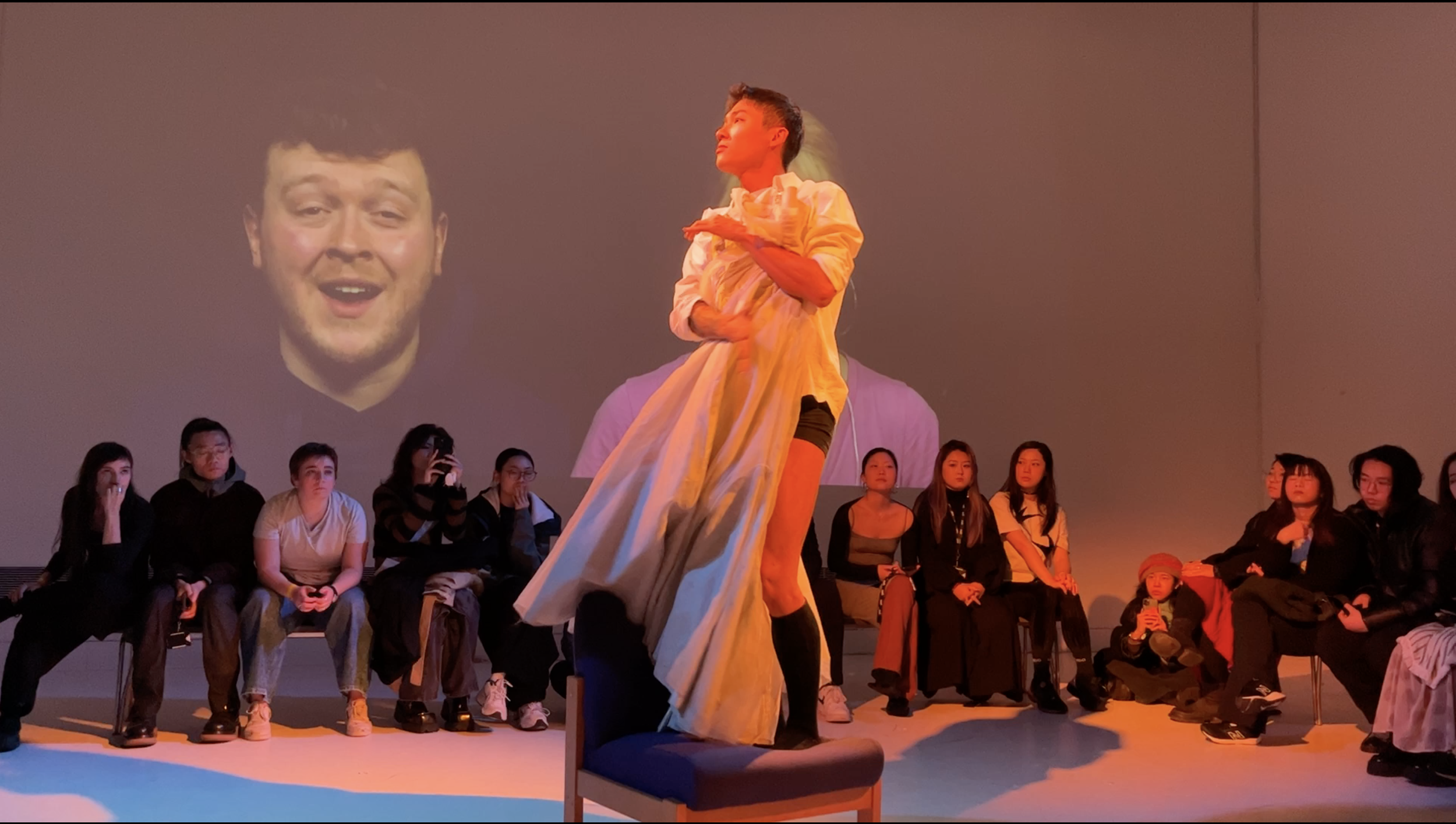
Live Performance Footage , White LAB 2023
Spatial configuration: nested zones and performed constraint
The space was organised as three nested zones. The outermost layer, four projected walls, functioned as a boundary condition rather than a backdrop. The audience sat inside this perimeter in a compressed, four-sided arrangement, unable to stabilise a single frontal viewpoint. The innermost zone held the performer’s actions, but theatrical behaviour did not belong only to the centre. The room itself functioned as a dramaturgical device.
A key procedure was boundary enforcement in darkness. Between the projection boundary and the seated spectators, a performer walked a narrow corridor in low light. Spectators could not clearly see the body, yet they could sense proximity and motion. This was not a theatrical trick. It was a way of staging power as a partly unverifiable condition that is felt as constraint rather than confirmed as image.
One audience moment clarified the enquiry more sharply than my own explanations could. During a projected sequence that indirectly referenced physiological shame, I noticed spectators avert their gaze. Several turned their heads away from the most confronting image. Yet, because projection surrounded them, avoidance did not resolve into escape. Instead, a turned head met another wall and another enlarged face, so that an attempt to look away produced an unexpected eye contact with the projection. In that moment, spectatorship appeared less as free choice and more as a field of forced relations. Refusal became a kind of encounter. What might be described as “internal” (shame, hesitation, self-protection) became legible as spatial behaviour, shaped by the environment’s distribution of gaze.
At this point my own distinction became clearer. I was not simply dividing space. I was composing a nested relation between social gaze (projection boundary), public bodies under pressure (audience zone), and private enquiry performed under exposure (action zone).
Audiovisual strand: grammar as apparatus; sensory overload and withdrawal
The moving-image material was informed by Bruce Nauman’s strategies of direct address and repetition, particularly the way a face confronting the viewer can operate as a disciplinary structure. Rather than citing his content, I translated his method into a grammatical machine: pronouns (I/you/he/she/they), copular verbs (is/am/was/were), and evaluative adjectives (good/bad/decent, etc.) attached to gendered nouns. The aim was to make judgement perceptible not as argument but as syntax, a structure that constantly allocates legitimacy.
Moving-image Experimental Footage, 2023 Performer Miles Golby, Lizzie Pinchard
Eight participants with diverse gender positions and readings recorded the same grammatical permutations. Their difference emerged through tone, rhythm, hesitation, and affect. This mattered because I did not want “diversity” to become an exhibition of identities. I wanted it to register as the unstable affective life carried by a stable grammar.
Sound was composed as pressure. Voices accumulated into overlap until speech became cognitively crowded. Then the audio dropped out while the image continued. Mouths moved, faces remained enlarged, but silence replaced voice. This withdrawal produced a perceptual shift. The audience leaned in, attention contracted, and the face became architectural. In this sequence, spectatorship was reorganised through sensory thresholds rather than through instruction.
Choreographic scores: translating reproductive interiority into generating principles
The live strand sought to avoid using choreography as illustration. I treated movement as method, using scores derived from reproductive interiority and organised around tension–release and contraction–expansion, with verticality and collapse as an orientation. Pollock’s practice offered a formal cue here. I approached it less as a biological reference and more as an enquiry into stance, gravity, dispersal, and the redistribution of control. What interested me was how a body shifts between containment and spill, and between upright legibility and collapse, under conditions of being watched.
Rehearsal Footage, London, 2023
In rehearsal, an initial attempt over-signalled the theme through recognisable gestures, which weakened the enquiry. I therefore revised the scores towards neutral actions under constraint, including sustained repetition, restricted range, and weighted stillness. This allowed meaning to emerge from pressure rather than depiction. The narrative premise remained minimal. The research focus was on the conditions that manufacture interiority, including how the body becomes managed, corrected, or defensively organised within layered gazes.
Ethics and care: exposure, pacing, and spectatorship
Because sensory overload and silent address can be confronting, I designed transitions and pacing to avoid shock as an end in itself. I treated pressure as a research tool rather than a spectacle. This meant moderating intensity, shaping durational thresholds, and keeping space for decompression and post-show reflection.
Provisional conclusion
Across the three strands, I learned to name my interest more precisely. Interiority is not something I represent; it is something I stage through spatial relations, sensory thresholds, and choreographic tasks. Gender appears not as identity to be explained, but as a situation organised by naming, gaze, and constraint. The research value lies in composing conditions so that interiority becomes external, perceptible, shareable, and contestable, without being reduced to explanatory narrative.